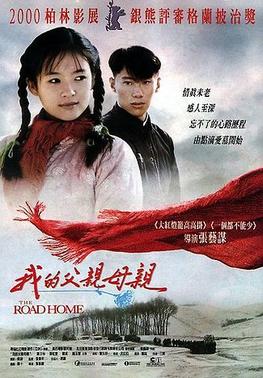
I think that Zhang Yimou, the director of The Road Home, chose to
incorporate fairytales and myth in the plot because it was a way of showing the
innocence of Zhao Di’s love when she was younger, and was also a way of having
Zhao Di express her feelings when she was older – so we as an audience
understood why she was experiencing so much grief at the loss of Luo Changyu.
The fairytale is demonstrated by showing the present time at the beginning of
the film in black and white, but then making the transition to color with Zhao
Di’s memories of how she fell in love with Luo Changyu, and then back to black
and white when she finishes telling the story. I thought the transition between
black and white and color in the film effectively demonstrated their love story
and how their fairytale both began and came to an end when he passed away. Using this strategy added to the emotional journey that we, as an audience, felt while watching the film; seeing their fairytale journey allowed us to view their struggles and hardships, as well as gain insight as to why Zhao Di and Luo Changyu fell in love with each other. It was
extremely enjoyable to watch overall.
Sunday, December 4, 2016
Final Part 2 - Visual Style Analysis
Enchanted and The Road Home have many similarities including the characters love story, and the symbolism throughout each film.

Symbolism is relevant in both films through the use of the color red - it represents
the hope each of the protagonists has that they will get to be with the person
they love. In The Road Home, Zhao Di
falls in love with the new school teacher, Luo Changyu, and wears a red scarf
each time she goes to visit him at the school. Her red scarf symbolizes the
hope she has that he will notice her. Later on in the film, Luo Changyu gives Zhao Di a red barrette before he has to return to the city. The red barrette
demonstrates that Luo Changyu reciprocates her love for him and that he hopes
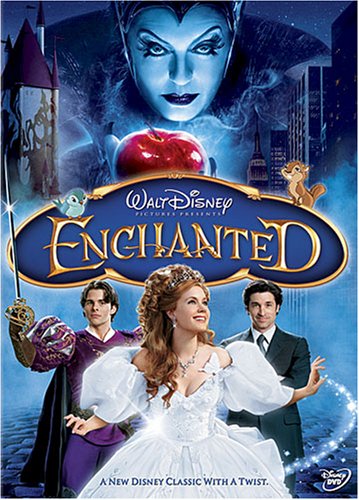
she will wait for him to return. In Enchanted, Giselle is tempted with a red
apple before she gets married to Prince Edward. She’d been having doubts about getting married
to Prince Edward and the apple represents the life she wishes and hopes she will
have with him. As the film progresses and she develops feelings for Robert
Philip, the apple later comes to represent the hope that they will be together
and that he will reciprocate the feelings she has for him.
The characters behavior is also similar between both films. In The Road Home, Zhao Di and Luo Changyu develop a close
and intimate relationship with each other, but when Luo Changyu is summoned to
return to the city she becomes sickly distraught at him not being around
anymore. This despair causes her to fall ill until he returns to her. In Enchanted, Giselle focuses her efforts on helping Robert
with his relationship with Nancy by showing him small ways he can demonstrate
his love for her. As she spends more time with him she realizes that its Robert
she has feelings for, not Prince Edward, and when she attends the ball she
becomes distraught when she realizes that they won’t be together. Queen Narissa
takes advantage of her vulnerability and convinces her that everything will
turn out okay if she eats the apple. Once she does, Giselle falls into a deep
sleep from which she can only be awoken by her true love. These two love stories are similar to each other because
both protagonists’ fall ill when they realize they can’t be with the person
they love most. It’s only when their love interest returns to them that they
can wake up.
Visual Style:
The visual style is similar in the way the directors
portray each film. In The Road Home,
the director uses black and white to represent the present time, and color to
represent the memories and flashbacks Zhao Di is having as she recalls the life
she had with Luo Changyu. In Enchanted,
the director uses animation to represent Giselle’s past life, the life she will
soon leave behind, and the use of real people to represent her new life and the
one in which she’ll find the person she truly belongs with.
The color scheme in
The Road Home and in the animated scenes in Enchanted is vibrant and full of
life (warm color palette), which demonstrates the desires and good feelings they once had. To demonstrate
the present time, the director of The Road Home showed the scenes in black and
white, and in Enchanted the director portrays the real world (when she
first appears in New York) as dull and lifeless so it was almost bordering on a
black and white color palette.

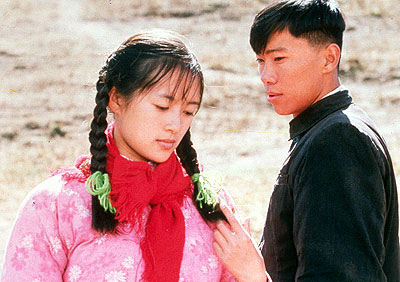
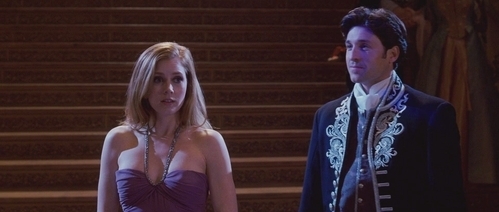
The visual style between both films is also similar in the way the characters are viewed by others, specifically by their love interests. Both Robert and Luo Changyu look at the protagonists with affection, which is demonstrated in the shots below. Both Giselle and Zhao Di are looking away from their love interest, whereas their love interest is completely focused on them. The directors choice of a close up for these scenes allows the viewer to see the expressions and emotions on each characters face; this demonstrates the love story between both characters.
Saturday, December 3, 2016
Pan's Labyrinth Featured Blogger Question
Prior to entering the Pale Man’s room, the faun warns Ofelia
not to eat or drink anything off the table, no matter how tempting it may be.
Despite successfully collecting the knife from the cupboard, and the warning not to eat or drink anything on the Pale Man’s table, Ofelia decided to eat a lush red grape anyways - blatantly ignoring the
faun’s warning.
1. Why do you think Ofelia chose to eat something off the
table?
2. What do you think would have happened if she hadn’t eaten
something off the table; was this action critical towards her completion of the
three tasks?
Tuesday, November 22, 2016
Final Presentation Proposal - Enchanted and The Road Home

Enchanted and The Road Home have many similarities that I’d like to explore further. Zhao Di falls in love with the new school teacher and follows him on the way home after school hours so they’ll meet.
In Enchanted, Giselle reminds Robert that the best way to show his girlfriend he loves her is to bring her flowers or sing to her. The similarity here is in how both protagonists have simplistic ways of getting their love interest to notice them.
The color red is also a symbol in both films, in that in each it represents hope (through the scarf and banners in The Road Home and in the apple in Enchanted).
Monday, November 21, 2016
Interesting Use of Music
An interesting use of music occurs in The Polar Express (2004) when the kids are about to receive hot chocolate on the train. The music incorporates the sounds of the waiters footsteps/dancing, the chairs revolving, and the tablecloths being put down. Each of the waiters movements are also emphasized by an instrument being played in the background. I thought it was interesting to incorporate sounds as a part of the music, rather than just having them be left as background noise. The music also conveys the mood of the kids in the scene (they are in awe and excited) and the waiters, as the instruments are very light and bouncy to match their dancing.
Water: Cultural Perspective
The film, Water, portrays the livelihood of women
widows in India during that time period. Widows were not allowed to remarry
because it was considered a sin, although many of them wanted to. Widows also faced
poor treatment and suffering. A comment is made in the film when the older
widow dies; they hoped she’d be reborn as a man. This comment demonstrates the
unhappiness the women found at becoming widows and the treatment they faced
because of that status. Alongside the treatment widows faced, the film also
included brief scenes that focused on messages from Gandhi’s movement. These
scenes demonstrated how public views on the treatment of widows were in the process of changing, including the views from the widows themselves.
Monday, October 24, 2016
Tsotsi: Sound and Music
I thought the opening scene’s sound and
music worked perfectly together. The scene shows Tsotsi and his friends at
Tsotsi’s house when one of the friends ask Tsotsi what they’d be doing that
night. An upbeat and almost powerful song begins playing when the camera
focuses on a close-up of Tsotsi’s face. The scene then cuts to them leaving the
house and walking along the street towards the city.
I thought the scene’s action and song
combination worked well together because the song seemed to give us an insight
into how others viewed Tsotsi. As the song plays, Tsotsi’s movements are very
controlled and purposeful, like he knows how to handle himself and what he needs to do in
order to survive in that environment. He also seems to be very focused during
this scene and the music seems to emphasize that since the music was also very
controlled and had a very direct beat to it. Tsotsi’s friends also walk
slightly behind Tsotsi which shows that they view him as the leader of their
group.
As the scene progresses, the sound of train
tracks and a train whistle are heard in the background. These sounds being used
in addition to the song seem to direct where the scene is going. It’s almost
like a preview of what’s to come is being shown because their robbery at the
train station is what started Tsotsi off on his journey to find value in his
life.
Sunday, October 23, 2016
Interesting Special Effect
I chose a special effect from The Mummy (1999) which shows Imhotep (played by Arnold Vosloo) chewing on a scarab that comes out of the side of his neck. This is one of my favorite films, and I thought it was interesting to see the process of this special effect being made. The clip above shows the CGI (computer generated image) process in which they made this effect. It describes how they first began with a computer model of Vosloo's face, to create the decayed area, before adding a scarab to run from a hole in his neck to the side of his face. Below I've included the clip from the movie that shows the completed process.
Saturday, October 15, 2016
Interesting Transition
I chose an interesting transition from the
TV show, Steampunk’d (2015). The show divides its participants into two teams
with the task of creating a room with an original steampunk design. At the end of each
episode, before eliminations take place, the final room is shown in comparison
to what the room first looked like. To do this, the show uses a dissolve
transition (an overlapping transition). The previous shot of the original room
dissolves into the shot of what the room looks like completed and a few seconds of
each of these shots is seen as they are overlapping. The use of the dissolve transition
in the show is used to show how much time has passed between what the room had
looked like before it was completed.
The Whale Rider: Historical Framework
While viewing The Whale Rider, I made sure to consider the historical context of
the film. The Whale Rider focused on
the traditions and life of the Maori people in New Zealand, including the
gender roles within their community. Prior to watching the film we were
informed of some of the traits of their gender roles, which included that men would perform the more laborious
tasks (such as carving) because they viewed as stronger, which also
coincided with the tradition of them fulfilling the leadership roles (such
as the role of chief). Women generally performed
household work and were valued for their childbearing abilities. These roles
were verbally demonstrated when Pai's grandmother commented during a family
dinner that, although Koro was in charge of everything outside, she was in
charge of the kitchen.
I thought it was interesting to
view these traditional roles in the film, and also view how they were altered
throughout the film by Pai. Pai was portrayed as a strong young woman who
constantly pushed the limitations of women’s roles in the film. When she wanted
to listen to the Maori lessons from Koro she decided to sit in the front row,
and even when Koro told her to move she didn’t move to the back row; she left
entirely. I really enjoyed watching Pai’s character become stronger and more
confident throughout the film, since she stretched how women’s roles
were being portrayed as she pursued the role of chief.
Monday, October 3, 2016
Interesting Camera Movement
The
interesting camera movement I chose appears in the film Mission Impossible: Ghost Protocol (2011) in the scene in which Tom
Cruise is going to scale the outside of a building.
As Tom Cruise approaches
the edge of the window the camera zooms in and pans up to show the distant
skyline in comparison to his silhouette, showing multiple buildings that are
shorter in comparison to the one he’s in, in order to demonstrate to the
viewers the height of the building he’s currently in and to emphasize the extremity
of what he’s about to do. The camera then pans up and shifts to focus on the
ground below him in a high angle shot, giving another view of how high up he
really is. As he prepares to climb it, camera tracking is used to follow him in
a high angle shot as he shifts his body to place his gloved hand on the glass. Through
the use of camera panning and tracking, the viewers are able to fully understand
what is at stake in the scenes and experience just how fearful the task is.
I wasn't able to get TubeChop to work, but I've attached a short clip that shows the scene I've described within the first 30 seconds.
Tuesday, September 27, 2016
The Road Home: Symbolism
An important
symbol I found after viewing the film was the banner that was placed in the
school house. Di made the banner early in the film, and by placing it in the
school, it was supposed to bring good luck. The banner was made with red yarn
and she dedicated much of her time to making sure the banner was tightly woven
so that it would last longer.
In the beginning of the film, after she finishes
the banner, it represents Di’s feelings towards the teacher and her hope that
they may be together. The symbolism of the banner changes towards the middle
of the film when the teacher becomes aware of her feelings towards him. He then treasures the banner and refuses to have the banner taken down, not
even for repairs. The symbolism changes again at the end of the film when it
becomes a symbol of their love for each other.
The banner is a constant object
in the film, since once it is placed in the school house, it remains untouched.
This represents the constant growth of Di and her lover’s feelings for each
other, and how a long lasting love is worth holding on to.
Sunday, September 25, 2016
The 400 Blows - Visual Style
A scene in The 400
Blows that I found to have interesting visual style was the shot in which
Antoine was stealing a typewriter from his stepfather’s work place. The shot is
a close-up of Antoine holding the typewriter as he’s leaving the room, with his
face half turned away from the camera. In this shot the viewers can see that
Antoine is focused on the task at hand, with his eyes focused on the floor and
each step he must take to exit the building without being caught.
A follow-up shot is then shown with Antoine holding the
typewriter, except this time he is caught by security after trying to return
it. This shot again shows Antoine, but his face is half obscured by shadows.
These are important shots to the plot of the film as they show Antoine’s transition
from one path in his life to another. Originally he was going to continue on with his
theft, but he changed his mind and decided to do the right thing by returning
it.
Sunday, September 18, 2016
Interesting Camera Angle or Shot
The interesting camera angle I chose is an extreme close-up from the film Pride and Prejudice and Zombies (2016). This camera angle was interesting to me because the shot shows the victim from the zombie’s point of view. In this scene the zombie’s vision is blurred, which distorts their view of the victim, and allows the viewers to see from the zombie’s perspective. The shot also captures the fear and surprise on the victim’s face as the zombie approaches her, using a dark color palette to emphasize her fear, as well as strike fear in the viewer.
Tuesday, September 6, 2016
About Me
Hello everyone!
My name is Natalie Trzcinko and I am a junior at Alverno College. I'm a Math major with supports in Film Studies and Business Analytics. Some of my current TV show obsessions include "New Girl", "The Flash", and "The Office".
Subscribe to:
Posts (Atom)