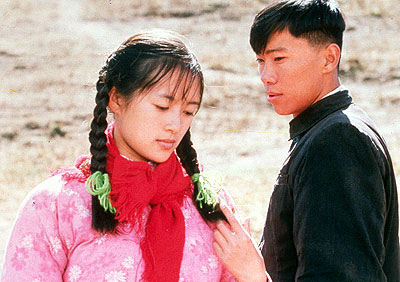
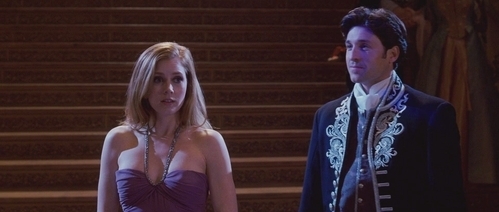
Enchanted and The Road Home have many similarities including the characters love story, and the symbolism throughout each film.
Symbolism is relevant in both films through the use of the color red - it represents
the hope each of the protagonists has that they will get to be with the person
they love. In The Road Home, Zhao Di
falls in love with the new school teacher, Luo Changyu, and wears a red scarf
each time she goes to visit him at the school. Her red scarf symbolizes the
hope she has that he will notice her. Later on in the film, Luo Changyu gives Zhao Di a red barrette before he has to return to the city. The red barrette
demonstrates that Luo Changyu reciprocates her love for him and that he hopes
she will wait for him to return. In Enchanted, Giselle is tempted with a red
apple before she gets married to Prince Edward. She’d been having doubts about getting married
to Prince Edward and the apple represents the life she wishes and hopes she will
have with him. As the film progresses and she develops feelings for Robert
Philip, the apple later comes to represent the hope that they will be together
and that he will reciprocate the feelings she has for him.
The characters behavior is also similar between both films. In The Road Home, Zhao Di and Luo Changyu develop a close
and intimate relationship with each other, but when Luo Changyu is summoned to
return to the city she becomes sickly distraught at him not being around
anymore. This despair causes her to fall ill until he returns to her. In Enchanted, Giselle focuses her efforts on helping Robert
with his relationship with Nancy by showing him small ways he can demonstrate
his love for her. As she spends more time with him she realizes that its Robert
she has feelings for, not Prince Edward, and when she attends the ball she
becomes distraught when she realizes that they won’t be together. Queen Narissa
takes advantage of her vulnerability and convinces her that everything will
turn out okay if she eats the apple. Once she does, Giselle falls into a deep
sleep from which she can only be awoken by her true love. These two love stories are similar to each other because
both protagonists’ fall ill when they realize they can’t be with the person
they love most. It’s only when their love interest returns to them that they
can wake up.
Visual Style:
The visual style is similar in the way the directors
portray each film. In The Road Home,
the director uses black and white to represent the present time, and color to
represent the memories and flashbacks Zhao Di is having as she recalls the life
she had with Luo Changyu. In Enchanted,
the director uses animation to represent Giselle’s past life, the life she will
soon leave behind, and the use of real people to represent her new life and the
one in which she’ll find the person she truly belongs with.
The color scheme in
The Road Home and in the animated scenes in Enchanted is vibrant and full of
life (warm color palette), which demonstrates the desires and good feelings they once had. To demonstrate
the present time, the director of The Road Home showed the scenes in black and
white, and in Enchanted the director portrays the real world (when she
first appears in New York) as dull and lifeless so it was almost bordering on a
black and white color palette.

The visual style between both films is also similar in the way the characters are viewed by others, specifically by their love interests. Both Robert and Luo Changyu look at the protagonists with affection, which is demonstrated in the shots below. Both Giselle and Zhao Di are looking away from their love interest, whereas their love interest is completely focused on them. The directors choice of a close up for these scenes allows the viewer to see the expressions and emotions on each characters face; this demonstrates the love story between both characters.